
You have booked a First Aid with CPR course. Perhaps your employer nominated you as a workplace first aider, perhaps you need it for your studies, or perhaps you simply want to be able to help your family. Either way, it helps to know what the day will be like. This guide walks you through it, from arrival to certificate.
For the full list of topics the course covers, see inside a First Aid with CPR course. For an overview of training options, see our guide to first aid training in Mumbai.
Why the day matters
Emergencies rarely happen next door to a hospital. If a person stops breathing, starts choking, is losing a lot of blood or has been burned, the actions of the people nearby in the first few minutes make the biggest difference. The course exists to make sure that, when that moment comes, you know what to do and have the confidence to do it.
Who you will be learning with
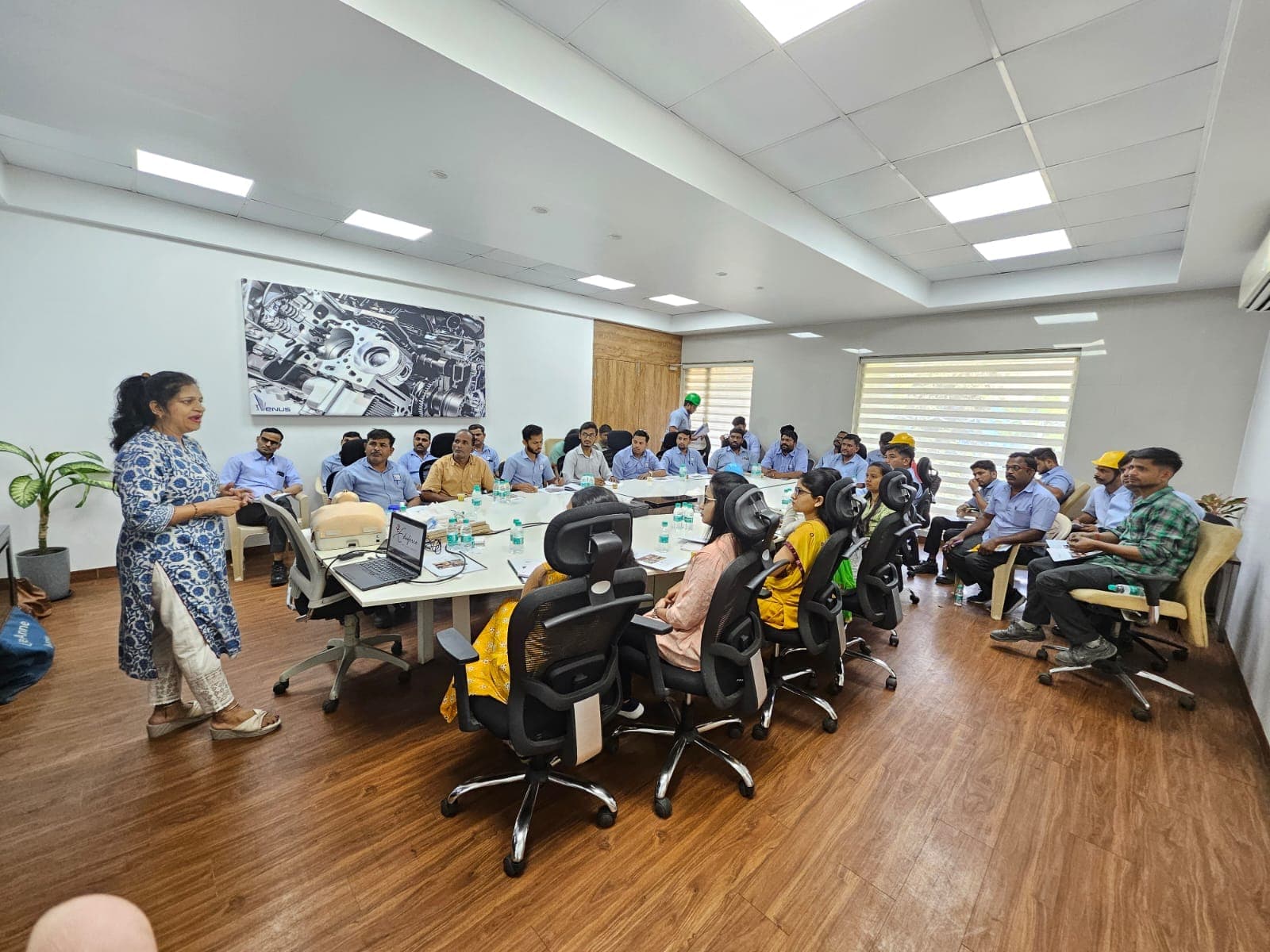
People come to First Aid with CPR training for many reasons. On a typical course you might meet:
- employees nominated as workplace first aiders, and members of safety teams
- people training for healthcare careers, such as nursing, medicine, physio or paramedic work
- people who work with children or in sport, including teachers, coaches and gym instructors
- parents, grandparents and carers
- people who simply want to learn life-saving skills
Nobody needs a medical background. Everyone starts from the same place.
What you will practise
The course follows a clear sequence, from arriving at an emergency to handing over to professional help:
- Scene safety and your role: making sure the area is safe, and understanding what a first aider does.
- Assessing the casualty: a primary survey of airway, breathing and circulation, and calling 112 with clear information.
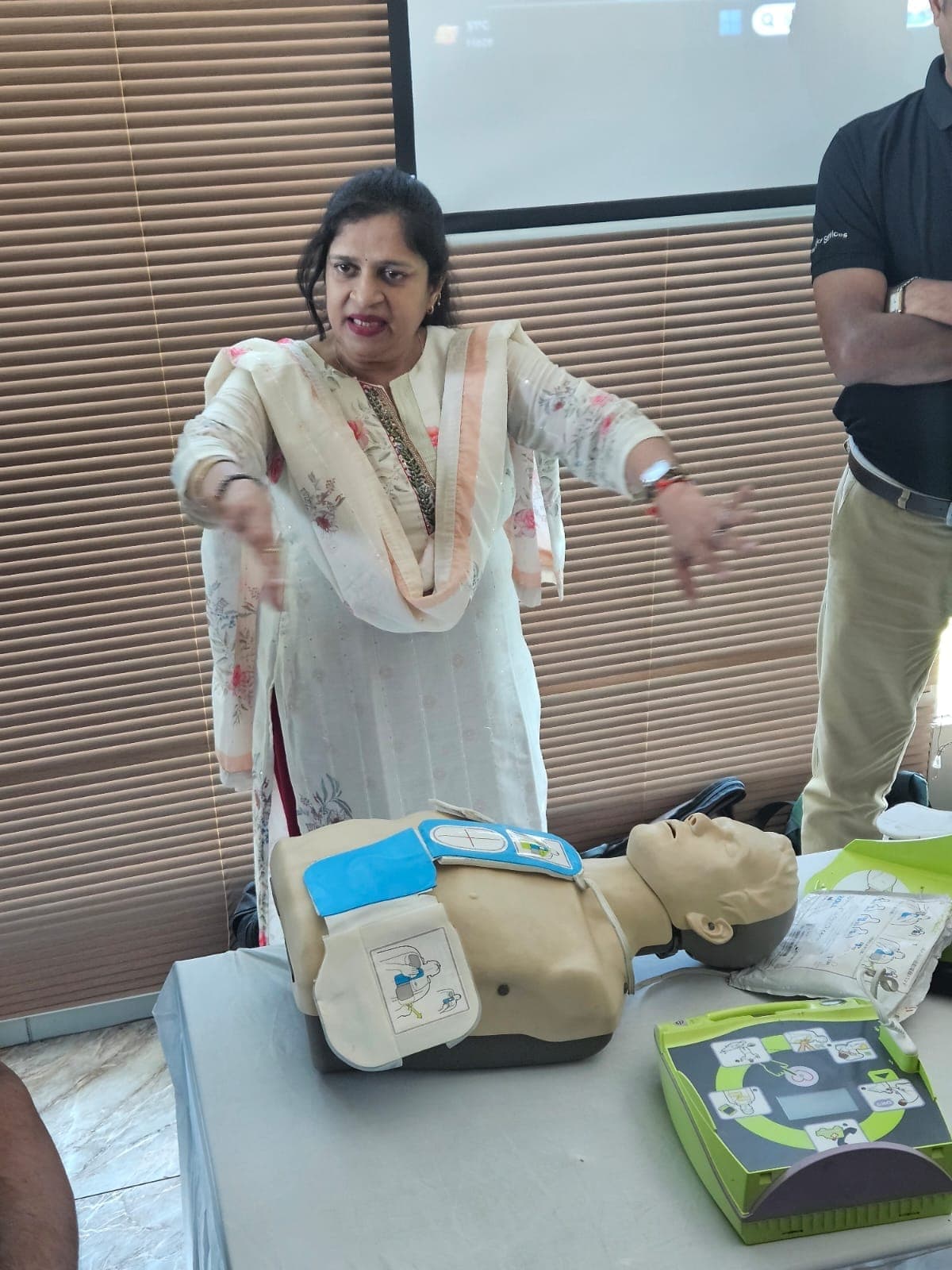
- CPR and the AED: cardiopulmonary resuscitation and using an AED, practised on manikins.
- Bleeding, burns, fractures and shock: controlling catastrophic bleeding, and caring for burns, fractures and shock.
- Recovery position and casualty handling: placing someone in the recovery position and moving a casualty safely.
- Handover: passing the casualty on to emergency medical services with the right information.
Many courses also cover medical emergencies such as heart attack, stroke, seizures and diabetic emergencies, as well as choking and heat-related illness. Ask the provider what your course includes.
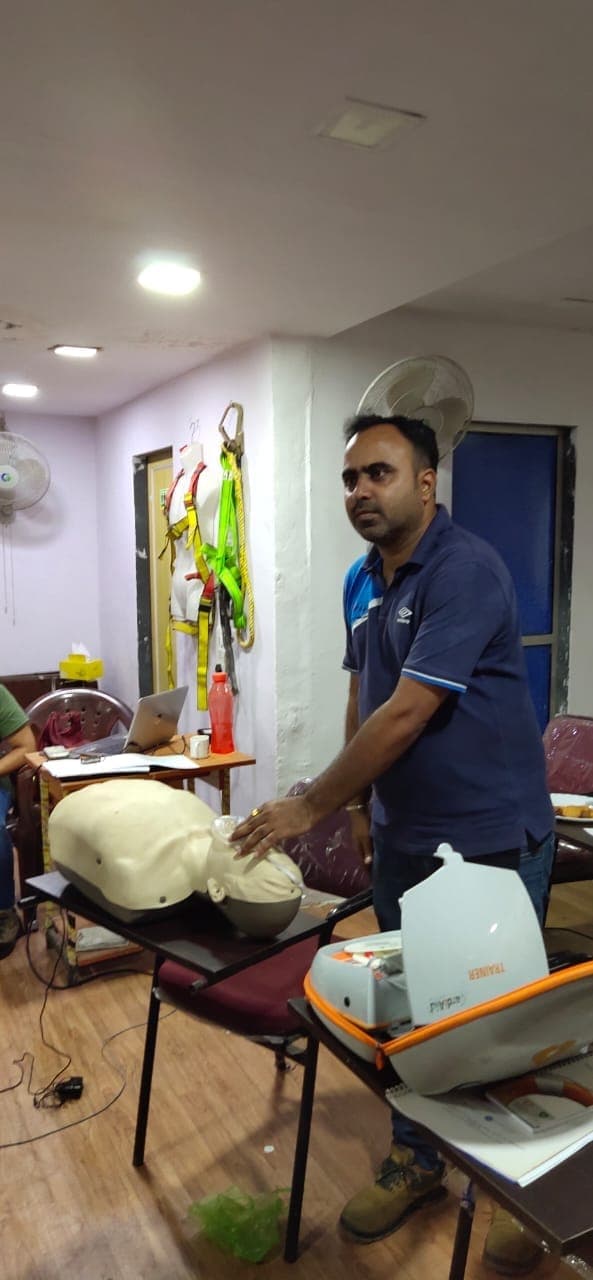
Skills are practised on manikins and in realistic scenarios until they feel automatic.
What to wear and bring
- Comfortable clothes you can kneel and move in. You will spend time on the floor practising CPR.
- Flat, comfortable shoes.
- Water and any medicines you normally need during the day.
- A notebook, if you like to write things down.
If you have a back, knee or wrist problem, are pregnant, or have any condition that might make the practical work difficult, tell the trainer at the start. Most activities can be adapted.
How to get the most from the day
- Ask questions. If something is unclear, ask. Someone else is probably wondering the same thing.
- Practise more than once. The second and third attempt at compressions or an AED sequence are where the skill starts to stick.
- Join in the scenarios. They can feel awkward at first, but they are the closest thing to a real emergency you will experience in training.
- Think about your own workplace or home. Where is the first aid kit? Is there an AED nearby? Who would you call?
At the end of the day
Participants are assessed on the key skills, and those who pass receive an Eduforce certificate. Keep it safe, note when it expires, and plan a refresher before then. Skills fade if they are not practised, so run through the steps in your head from time to time.
What comes next
Many people find that one course is the start, not the end. Depending on your role, you might go on to:
- Advanced First Aid Certification, for higher-risk settings
- First Aid and CPR Training to International Guidelines, based on current American Heart Association (AHA) guidelines
- Basic Life Support (BLS), for those who may need to manage a cardiac arrest
For factories and industrial workplaces in Maharashtra, our DISH Certified First Aid programme is delivered under the approval of the Directorate of Industrial Safety and Health.
Booking with Eduforce
Our First Aid with CPR training prepares workplace responders to assess a casualty, act on life-threatening findings and hand over to professional help. Training can take place at our training centre, and companies can arrange training at their own premises.
For upcoming dates, write to info@eduforce.in, call 7498845111 or message us on WhatsApp at 8779291591.
Learn the skills today, so you are ready when someone needs you.
In an emergency, call 112.
Related training
- First Aid, Health & MedicineFirst Aid with CPR TrainingView programme
- First Aid, Health & MedicineAdvanced First Aid Certification TrainingView programme
- First Aid, Health & MedicineFirst Aid and CPR Training to International GuidelinesView programme
- First Aid, Health & MedicineBasic Life Support (BLS) TrainingView programme
Need help developing workplace safety capability?
Talk to Eduforce about training, consultancy and safety solutions.
Eduforce Team
EHS Training & Safety Solutions
Practical safety guidance from the Eduforce trainers and consultants — written from the training centre, the classroom and the site.
More about Eduforce