
GWO Advanced Rescue Training (ART)
Advanced casualty rescue capability for complex wind turbine scenarios.
The Training
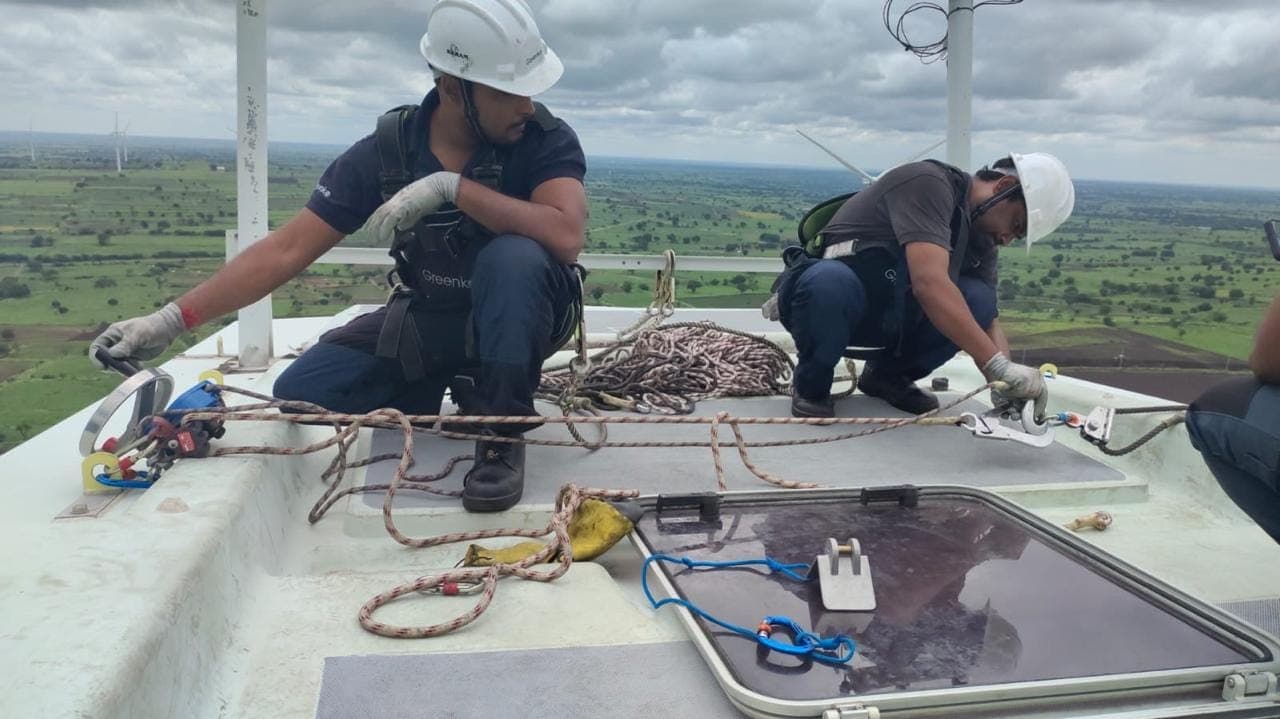
Training overview
Advanced Rescue Training goes beyond the basic rescue taught in Working at Height. It develops the capability to plan and carry out the rescue of an injured person from the most difficult positions inside a turbine — the hub, the spinner, the interior of a blade, the nacelle, the tower and the basement — using industry-standard equipment and technique.
The standard is delivered as two modules that can be taken separately according to the areas a team is responsible for. Both cover emergency response planning, injury prevention during the rescue itself, packaging and stabilising an injured person, and lowering and raising systems.
Both modules also train single-rescuer scenarios, preparing personnel to act where a two-person team is the realistic maximum. Training takes place on mock-ups built to defined dimensions, so the confined spaces participants practise in reflect the real thing.
Why this training matters
When someone is injured deep inside a turbine, a conventional rescue is not possible and the clock is running. Advanced Rescue Training exists so that a site has people who can plan and execute a recovery from those positions, and hand the casualty over to emergency services safely.
What you will learn
- Determine rescue and evacuation strategies for the relevant turbine areas
- Communicate clearly with emergency responders and coordinate handover of the injured person
- Act as team coordinator during descending rescue operations to an assembly area
- Package and stabilise an injured person for movement
- Assess and plan single-rescuer strategies for selected scenarios
Training pathways
Initial Training
Delivered as the hub/spinner/blade module, the nacelle/tower/basement module, or both.
Duration: 12 hours contact time per module (approximately 1½ training days)
Refresher / Renewal
In transitionRefresher training is required every 24 months. Participants must hold a valid initial training record together with current Basic Safety Training certification.
Duration: 7 hours 30 minutes per module (ART-HR and ART-NR)
Training content
GWO ART-Hub, Spinner and Inside Blade Rescue (SR-H)
Rescue operations within the hub, spinner and blade interior.
12 hours contact time (approximately 1½ training days)
View ModuleGWO ART-Nacelle, Tower and Basement Rescue (SR-N)
Rescue operations across the nacelle, tower and basement sections.
12 hours contact time (approximately 1½ training days)
View ModuleKey knowledge
- Emergency response planning within an organisation
- Injury prevention measures during a rescue
- Injured person packaging and stabilisation
- Lowering and raising rescue systems
- Enclosed and confined space rescue principles
Practical skills
- Conducting descending rescue operations to a primary or secondary assembly point
- Rigging and operating lowering and raising systems
- Packaging an injured person for extraction
- Executing rescues as a two-person team and as a single rescuer
Safety and risk awareness
- Maximum fall factor of 0.5 during training activity
- Minimum recommended anchor point height of 6.75 m
- Additional fall protection is mandatory throughout training at height
- Confined and enclosed space hazards within hub, spinner and crawl spaces
Competencies
- Determine a rescue and evacuation strategy for the relevant turbine area
- Apply clear communication protocols with emergency responders
- Coordinate handover of the injured person
- Perform team-based descending rescue operations
- Assess and plan single-rescuer scenarios
Key learning outcomes
- Rescue operations and planning
- Work at height rescue techniques
- Selection and use of rescue equipment
- Practical rescue scenarios
- Emergency response coordination
Assessment
Direct observation of practical exercises and supplementary oral questions, recorded on the GWO Participant Performance Assessment form.
Practical training
Scenario-based practical work in purpose-built mock-ups, with additional fall protection mandatory throughout training at height.
Important information
- Maximum 8 hours contact time per training day.
- Training uses mock-ups built to defined dimensions so confined-space practice reflects real turbine geometry.