
First aid can be learned in more than one way. Some people sit in a classroom at a training centre. Some companies bring the trainer to their own site. And more and more courses offer part of the learning online. Each format has its place, but they are not interchangeable, and one rule applies to all of them: CPR has to be practised with your hands.
This guide compares the options so you can choose the right one. For an overview of training in the city, see our guide to first aid training in Mumbai.
Why the format matters
For many organisations, first aid training is not optional. In Maharashtra, the Directorate of Industrial Safety and Health (DISH) enforces workplace safety law in factories, including first aid requirements. That law is now the Occupational Safety, Health and Working Conditions Code, 2020, which replaced the Factories Act, 1948 in November 2025. Healthcare, wind energy and other sectors look for certification such as American Heart Association (AHA) or Global Wind Organisation (GWO) courses. Whatever format you choose, it must lead to the certificate you need, and it must leave people able to act.
Classroom training at a centre
People travel to a training centre and learn together, in a room set up for the purpose.
Strengths
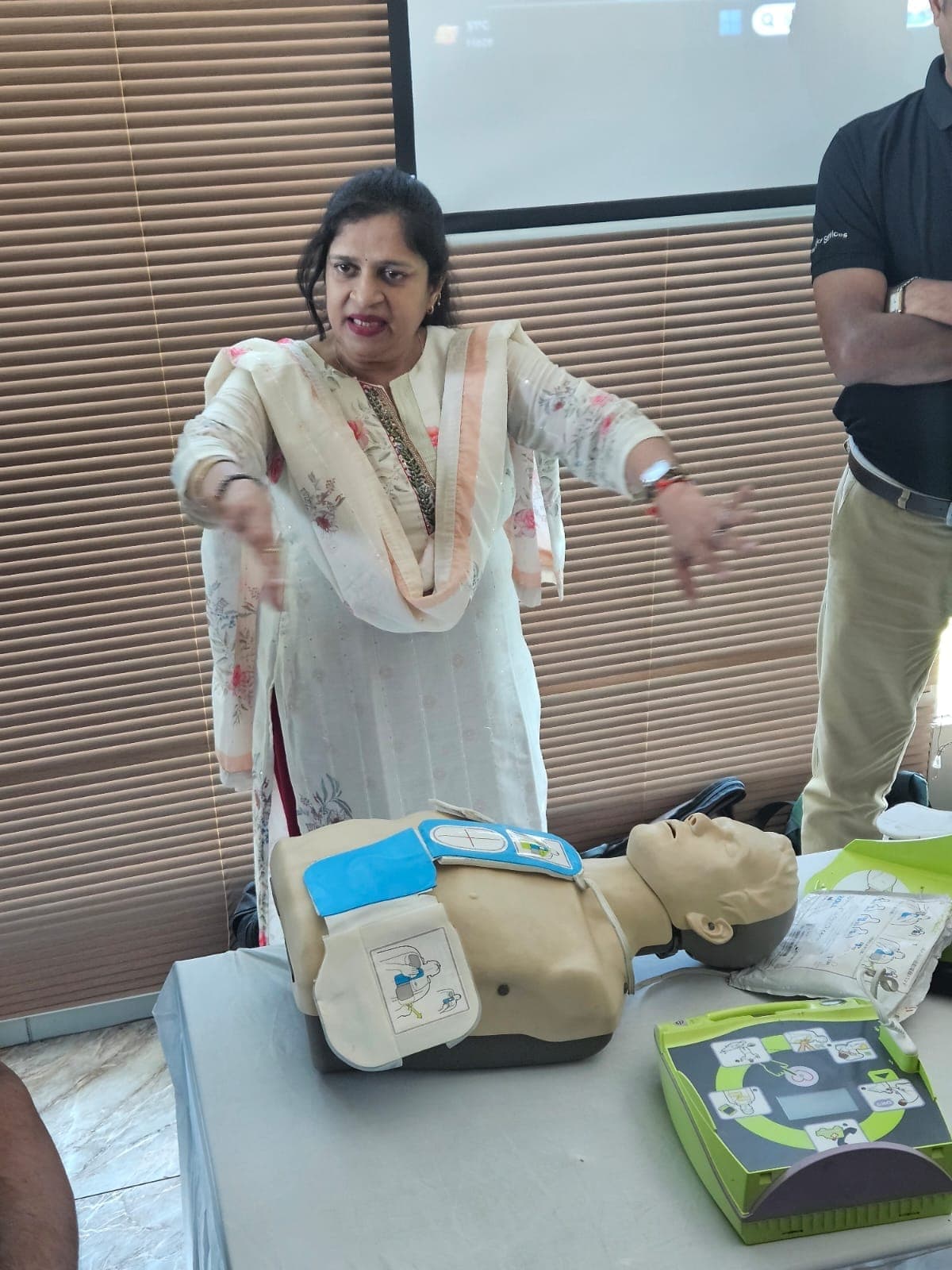
- equipment ready to hand, including CPR manikins and AED trainers
- a focused setting, away from day-to-day work
- the chance to learn alongside people from other organisations
Limitations
- travel time and time away from work
- scenarios are less tailored to any one workplace
On-site training at your workplace
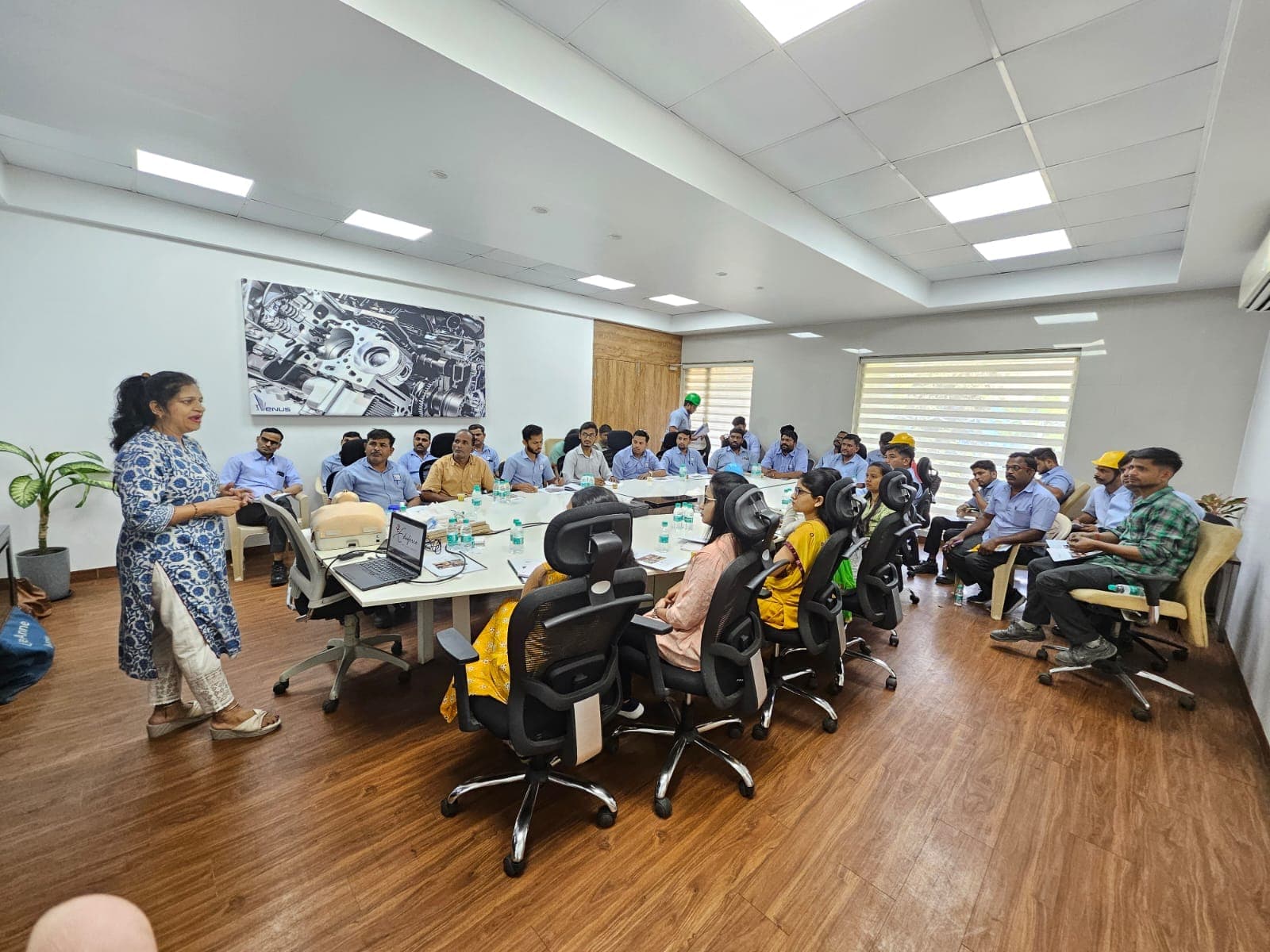
The trainer comes to you, and your team trains together at your own premises.
Strengths
- no travel for participants, so less time away from work
- scenarios built around your own site, equipment and hazards
- teams who will respond together learn together
Limitations
- you need a suitable room and space to practise on the floor
- people may be pulled back into work during the day
Online learning
Participants study theory on a computer or phone, at their own pace.
Strengths
- flexible timing, which suits busy schedules and shift work
- useful for revising knowledge before or after a practical course
Limitations
- you cannot learn CPR, bandaging or using an AED from a screen
- no way for a trainer to check and correct your technique
Blended learning
Some courses combine online theory with a shorter practical session in person, where participants practise and are assessed. Done well, this can reduce time away from work. But the practical session is essential, and it must be long enough for everyone to practise properly.
Comparing the formats
| Classroom | On-site | Online only | |
|---|---|---|---|
| Hands-on CPR practice | Yes | Yes | No |
| Scenarios tailored to your workplace | Limited | Yes | No |
| Time away from work | Higher | Lower | Lowest |
| Trainer checks technique | Yes | Yes | No |
| Suitable for certification on its own | Yes | Yes | Rarely |
The non-negotiable: hands-on practice
Whatever format you choose, make sure it includes practice on CPR manikins and AED trainers with a trainer watching. Chest compressions need the right depth, rate and hand position, and only practice builds that. A video can remind you of the steps; it cannot teach your hands.
What a good course should cover
- Basic Life Support: CPR for adults and, on many courses, children and infants
- AED operation: using a defibrillator safely
- Injuries: fractures, severe bleeding and burns
- Environmental emergencies: heatstroke and snake bites
- Sector-specific needs, such as remote first aid for wind energy
Which format is right for you?
- An individual wanting a recognised certificate: a classroom course at a training centre.
- A company training a team or an emergency response team: on-site training, built around your own workplace.
- Anyone refreshing knowledge between courses: online material can help, alongside regular practical refreshers.
- A remote site with a small team: on-site training avoids sending everyone away at the same time.
How Eduforce delivers first aid training
Eduforce delivers first aid training at our training centre and at clients' own sites, with hands-on practice. Our first aid training programme is approved by the Directorate of Industrial Safety and Health (DISH), Government of Maharashtra, and we also run First Aid and CPR Training to International Guidelines, based on current American Heart Association (AHA) guidelines, and GWO first aid training.
To discuss the right format for your team, write to info@eduforce.in, call 7498845111 or message us on WhatsApp at 8779291591.
In an emergency, call 112.
Related training
Need help developing workplace safety capability?
Talk to Eduforce about training, consultancy and safety solutions.
Eduforce Team
EHS Training & Safety Solutions
Practical safety guidance from the Eduforce trainers and consultants — written from the training centre, the classroom and the site.
More about Eduforce